

 I was at a crab feast over the weekend when I found myself talking with a man I’ll call Tom. He’s a successful entrepreneur who built a restaurant business locally, eventually sold it, and now works a few days a week at a local hardware store mostly because he enjoys it.
At some point, our conversation turned to the younger people working there, and Tom said something I’ve heard from business owners and leaders for years: “Nobody wants to work anymore.”
Tom had plenty of evidence, or at least he thought he did. There are three young men working at the store, and he had taken time to talk with each of them about their futures. I actually loved that about him. He wasn’t simply criticizing them from a distance; he genuinely wanted to see them do something with their lives.
One of the young men told Tom he was interested in learning a trade. Tom immediately encouraged him to pursue it. Go find out about the program. Get an application. See what you need to do. Don’t wait. Take some action.
A week later, Tom asked him what he had done. Nothing. The program was about an hour and a half away, the young man explained. It was just too far.
To Tom, this was evidence of exactly what he had been talking about. Here was a young man with an opportunity to create a better future, and he wouldn’t even drive 90 minutes to investigate it.
Tom began telling me about all the things he had done when he was young to create the success he eventually had—the hours he worked, the sacrifices he made, the inconveniences he endured, the things he figured out because nobody was going to figure them out for him. Young people today, he told me, simply don’t have that kind of drive.
Maybe you’ve said something similar. Maybe you’ve looked at a young employee who didn’t take initiative or follow through and wondered what happened to work ethic.
But there’s a problem with the conclusion that “nobody wants to work anymore.” We know what someone did or didn’t do, but we know far less about why.
As Tom talked, I started asking him about the young man. Where did he come from? What had his life been like? What did he want for himself? Why was he interested in learning a trade? Did he have children or other responsibilities? What might be standing between him and that 90-minute drive?
Tom couldn’t tell me much. That struck me because Tom genuinely wanted to help him. His intentions were good. But he was trying to influence someone he didn’t really know. Without knowing much about the young man’s story, Tom filled in the missing information with an explanation based on his own: If I were his age and wanted something badly enough, I would find a way to get there. He isn’t finding a way, so he must not want it badly enough.
Leaders do this all the time. We see someone’s behavior and quickly decide what it means. He didn’t make the drive, so he isn’t motivated. She doesn’t speak up in meetings, so she doesn’t care. He leaves at five, so he isn’t committed. She needs more direction than we think she should, so she lacks initiative.
But what if we don’t know enough yet? Maybe this young man doesn’t have reliable transportation. Maybe he’s intimidated by walking into an unfamiliar place alone. Maybe nobody in his family has ever pursued a trade. Maybe he’s carrying responsibilities Tom knows nothing about. Maybe an hour and a half represents something entirely different in his life than it does in Tom’s.
I don’t know. And neither did Tom. As I listened, I imagined myself in the young man’s position. What might it feel like to drive an hour and a half alone to an unfamiliar place, walk through the doors and essentially say, I don’t know how any of this works, but I’d like a chance?
For someone who has spent decades building businesses, taking risks and walking into unfamiliar rooms, that may not seem particularly difficult. For someone else, it might feel enormous.
So I asked Tom, “Why don’t you offer to take him up there?” He looked at me like I was crazy. And I understood why. From Tom’s perspective, he had already helped. He had asked about the young man’s future, pointed him toward an opportunity and encouraged him to act. At some point, shouldn’t the young man have to take responsibility for himself?
Of course he should. But taking responsibility for ourselves and needing support are not opposites. Offering to drive him there wouldn’t mean filling out the application for him or getting him the job. It wouldn’t mean making sure he gets out of bed every morning or protecting him from the consequences if he doesn’t show up.
It would simply mean helping him across a part of the journey that may currently feel too big to cross alone. Once they arrived, the young man would still have to walk through the door, ask the questions, fill out the application and ultimately prove that he was willing to do the work.
 I think we’ve created a false choice in many workplaces. Either people have drive and figure things out for themselves, or we’re coddling them. Either they overcome obstacles on their own, or we’re lowering the bar.
But good leadership isn’t about lowering the bar. It’s about understanding where someone is starting and helping create the conditions in which they have a real opportunity to reach it.
The longer we lead, the easier it can be to forget our own starting point. A successful entrepreneur can look backward and see all the obstacles he overcame. What’s harder to remember is what those obstacles felt like before he knew he could overcome them.
Once we’ve crossed a bridge enough times, we can forget how frightening it looked when we were standing on the other side for the first time. And that’s where “nobody wants to work anymore” becomes dangerous. It doesn’t just describe our frustration. It can stop our curiosity.
Once I decide you’re lazy, why would I ask what’s getting in your way? Once I decide you’re entitled, why would I learn about your life? Once I decide your generation lacks work ethic, why would I wonder whether there is something I could do differently to help you discover what you’re capable of?
That doesn’t mean leaders should endlessly invest in people who repeatedly refuse to invest in themselves. Accountability matters. Expectations matter. Effort matters. Ultimately, people have to choose what they do with the opportunities in front of them.
But before we decide someone lacks work ethic, perhaps we ought to know enough about the human being in front of us to understand what we’re actually seeing.
So the next time you find yourself thinking, Nobody wants to work anymore, replace the conclusion with a question:
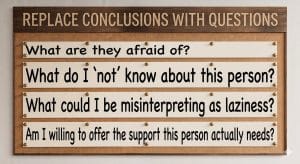 What don’t I know yet? What don’t I understand about this person? What matters to them? What are they afraid of? What are they trying to create? What am I interpreting as laziness that might actually be uncertainty, fear, lack of exposure or simply not knowing how to take the next step?
And perhaps the harder question for leaders is this: Am I willing to offer the support this person actually needs, rather than only the support I think they should need?
Tom had already given this young man something valuable. He saw possibility in him. He cared enough to ask about his future and encourage him toward something more.
Maybe the next step isn’t telling him one more time what he should do. Maybe it’s saying, “I’m off Tuesday. If you really want to explore this, I’ll drive up there with you.” Then we get to see what the young man does with the opportunity. Because leadership isn’t doing the work for people. It isn’t dragging them toward a future they don’t want, and it isn’t lowering expectations.
 Sometimes it’s being willing to understand where someone is starting—and helping them get far enough down the road that they can begin to see what they’re capable of doing for themselves.
Here’s to your greatness,
Misti Burmeister
Misti Burmeister is a leadership communication expert who helps founder-CEOs and senior leaders build trust, strengthen accountability, and create ownership through courageous conversations and human-centered leadership. Her work focuses on helping leaders notice what others miss in human dynamics so they can communicate in ways that help people succeed — not just comply.