
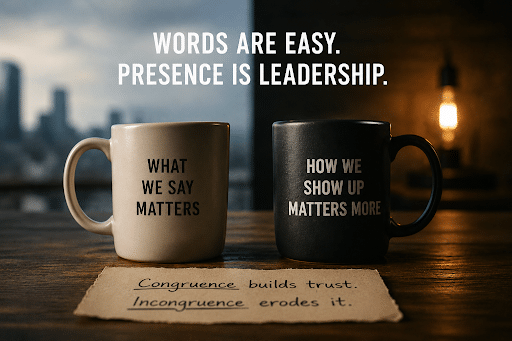
 A few years ago, if someone told me they taught difficult conversations, servant leadership, or emotional intelligence, I probably would have assumed they were deeply self-aware. Now, I’m not so sure. Not because I think people are intentionally deceptive, but because I’ve come to realize something uncomfortable: Leadership language has evolved faster than human self-awareness.
Today, people can speak fluently about leadership concepts while remaining profoundly disconnected from their own internal experience. They can teach accountability, communication, trust, empowerment, psychological safety, servant leadership, and emotional intelligence—and still struggle to take responsibility, tolerate discomfort, acknowledge emotion, or stay grounded in difficult relational moments. That doesn’t make them bad people. It makes them human. But it can create a kind of incongruence that others feel, even when they can’t fully explain what they’re sensing.
The Moment That Changed Something for Me
Recently, I found myself reflecting on an interaction with someone who teaches difficult conversations. At one point, he casually said, “I don’t do emotions.” I remember pausing internally because difficult conversations are not difficult because of the words alone. They’re difficult because disappointment is present. Shame is present. Fear is present. Uncertainty, attachment, rejection, and identity can all be present whether we consciously acknowledge them or not. Humans do not experience conflict cognitively alone; our bodies and nervous systems are part of the conversation.
That moment made me realize something important: A person can intellectually understand leadership while remaining disconnected from parts of their own internal experience. We can know the frameworks, teach the models, use the language, and facilitate the process. But embodiment is something else entirely. It’s one thing to know how to guide a conversation structurally. It’s another to remain present with ourselves and others when discomfort enters the room.
The Difference Between Performing Leadership and Embodying It
 I think many leaders genuinely want to see themselves as servant-oriented, empowering, emotionally intelligent, collaborative, and trustworthy. But wanting to be something and consistently embodying it are not the same thing. Sometimes leadership identity becomes aspirational rather than actual. The language becomes a story we tell ourselves about who we are, rather than an honest reflection of how we consistently show up under pressure. That distinction matters because eventually people stop responding only to our words and begin responding to what they experience in our presence.
They notice when accountability is taught but avoided, when collaboration is preached but control dominates, when servant leadership is claimed but resentment quietly leaks through, or when emotional intelligence is discussed while emotional reality is denied. We may be able to manage our language for a while, but it is much harder to manage everything else we communicate.
The Leadership Identity Trap
One of the most difficult things for any of us to confront is the gap between who we want to believe we are and how we actually show up when challenged. That gap doesn’t necessarily exist because we are dishonest or intentionally trying to deceive anyone. Identity is emotionally loaded, and information that contradicts the way we see ourselves can feel threatening.
If I believe “I am a servant leader”, evidence that challenges that identity can feel like more than feedback about my behavior. It can feel like a threat to who I believe I am. Instead of becoming curious, I may explain, deflect, intellectualize, rationalize, avoid, or perform certainty. I may not even realize I’m doing it.
This is where leadership can become performative without someone intentionally performing. The image becomes safer than the truth, particularly when shame is nearby. And perhaps the real work of self-awareness is developing enough capacity to become curious about the gap rather than immediately protecting ourselves from seeing it.
Why Affective Awareness Matters
This is one reason I’ve become increasingly interested in affective awareness: our capacity to notice the signals our bodies are giving us and remain curious about what those signals may be communicating, rather than immediately assuming our interpretation is true or acting from it. Sometimes something happens inside us before we have words for it. A tightening. Heat. Pressure. A knot in the stomach. An urge to explain, defend, fix, control, withdraw, or prove ourselves. Then the mind begins making meaning of what the body has already noticed.
Underneath that response might be fear of rejection, a need to look competent, exhaustion, the desire to be helpful, discomfort with disappointing someone, or an attachment to being needed. The signal itself doesn’t prove any of those things. But noticing it gives us the opportunity to become curious before our explanation hardens into certainty.
That happens before the leadership language, before the polished response, before the strategy. When we lose connection with those early signals, we can begin managing perception instead of becoming curious about reality. Trust can start to erode—not necessarily because people consciously analyze every inconsistency, but because human beings notice when someone’s words and their experience of that person don’t quite match.
People Trust Congruence More Than Titles
The older I get, the less interested I am in how leaders describe themselves. I’m much more interested in what happens when reality challenges the description. Can we tolerate honest feedback without immediately defending ourselves? Can we acknowledge reality without collapsing into shame? Can we remain present when a conversation gets uncomfortable, admit when we didn’t follow through, distinguish our intention from someone else’s experience of our impact, and stay connected to ourselves while remaining connected to another person?
That, to me, is leadership. Not perfection. Congruence. And perhaps one of the most important questions we can ask ourselves isn’t “What kind of leader do I believe I am?” It’s” What do people consistently experience from me—especially when I’m under pressure?”
There may be a gap between those two answers. There certainly have been gaps in my own life and leadership. The goal isn’t to shame ourselves for finding them. The opportunity is to notice them, get curious about what is happening underneath them, and decide what we want to do next. Because knowing the language of leadership is valuable. Teaching it can be valuable, too. But the real test begins when the framework meets the human being.
What happens inside you when your leadership identity is challenged?
That moment—before the explanation, before the defense, before the reaction—may tell you more about your leadership than any title, model, or set of words ever could.
Here’s to your greatness,
Misti Burmeister
About Misti
Misti Burmeister is an executive coach, leadership advisor, bestselling author, and keynote speaker who has spent more than 20 years studying what helps people care, contribute, and take ownership. Her work explores what happens beneath communication—the assumptions, reactions, and patterns that shape how we lead, make decisions, and relate to one another.
She is the author of four published books and is currently writing Before the Reaction: Where Leadership Actually Begins, which explores the often-unnoticed moments before we speak, decide, judge, or react—and how noticing those moments can give leaders greater clarity and choice.
If your organization is navigating difficult conversations, leadership pressure, accountability, or the challenge of creating greater ownership, Misti brings these ideas to life through keynotes and executive coaching. Her work helps leaders move beyond knowing what good leadership sounds like toward practicing it when the stakes are real.
To explore booking Misti for a keynote or working with her through executive coaching, email [email protected].