
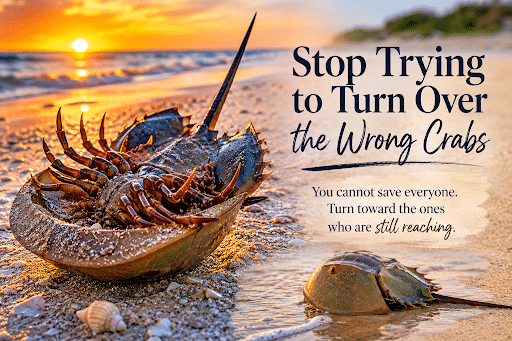
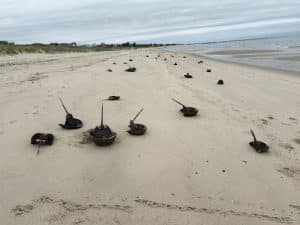
Earlier this summer, after a storm rolled through Lewes, I was walking on the beach when I saw them everywhere: hundreds of horseshoe crabs flipped upside down in the sand. Some were still moving their legs frantically, trying to right themselves before the sun and exhaustion took over. Others were motionless. The storm had tossed them over and left them stranded.
I started turning them back over one by one. Almost immediately, another thought hit me: I cannot possibly save all of these crabs by myself. So I posted in a local Facebook group asking for help. But somewhere between turning over crabs and waiting to see if anyone would come, something deeper surfaced in me. I realized how much of my life I had spent trying to turn over the wrong crabs.
For years, I kept going back to people hoping for love, encouragement, safety, and validation from people who simply did not have the capacity to offer those things to me. I wanted my family to love me in ways they never had. I wanted warmth where there had been ridicule, tenderness where there had been shaming, care where there had often been cruelty.So I kept trying harder. I explained more. I performed better. I accomplished more. I became more useful, more accommodating, more lovable—or at least I tried to be. Somewhere inside me was the belief that if I could just get it right, I could finally get from them what I had spent so much of my life wanting.
But no amount of effort could create emotional capacity where it did not exist. Eventually, I had to face something painful: I was going to the wrong people looking for love. Not wrong in the sense that family shouldn’t love you, but wrong in the sense that these particular people had never shown the ability to love me in the ways I needed. That realization changed my life. Not because I stopped caring about them, but because I stopped abandoning myself trying to force connection where mutuality did not exist. I began learning that accepting what someone is capable of giving me is different from deciding what I should have deserved from them.
Standing on that beach that day, I realized something else, too. The crabs in front of me were still reaching toward life. Some were moving furiously. Some barely at all. I couldn’t save every one of them, but I could put my energy toward the ones in front of me and do what I could. And that is increasingly where my energy goes in my life, too: toward people who are capable of love and able to receive it. Toward relationships rooted in mutuality instead of survival. Toward communities where people show up for one another. I am learning to stop spending my life trying to convince closed hearts to open. I could not save every horseshoe crab that day. I could only help the ones in front of me.
Maybe healing is not learning how to save everyone.Maybe healing is learning where love can actually land. If this resonates with you, I hope you’ll share it. So many people are quietly exhausting themselves trying to force connection, approval, or engagement where mutuality does not exist.
And perhaps this reaches beyond our most personal relationships. Leaders do this, too. We pour more and more energy into trying to force engagement,  ownership, trust, or change. Sometimes the question isn’t How do I try harder? Sometimes it’s Where can my energy actually make a difference? Where are we pouring energy into trying to force engagement, ownership, trust, or change—and where might that energy actually make a difference? Leadership isn’t about carrying everyone. It’s about becoming more intentional about what is ours to carry, where our influence can matter, and where we may need to let go. That is a question I spend a lot of time exploring in my coaching, speaking, and leadership work: how we notice what we’re carrying, distinguish what belongs to us from what doesn’t, and choose where our energy can actually create something meaningful. These are the kinds of conversations I bring to leaders and organizations through my speaking and coaching.
Here’s to your greatness,
Misti Burmeister
Misti Burmeister is a leadership communication expert who helps founder-CEOs and senior leaders build trust, strengthen accountability, and create ownership through courageous conversations and human-centered leadership. Her work focuses on helping leaders notice what others miss in human dynamics so they can communicate in ways that help people succeed — not just comply.