
 I’ve carried a long and complicated history with my family—marked by pain, silence, longing, and eventually, a line I could no longer pretend not to see. When faced with something I could not ignore, I chose truth over belonging. And as a result, the shape of “family” changed for me—suddenly, profoundly, and maybe permanently.
Even now, there are parts of me that still ache for connection. Not surface conversation. Not politeness. Something real. Mutual. Rooted in care. And while I’ve accepted that I may never fully have that with the people I come from, I’ve realized something else too: Sometimes, the hardest boundary we ever set is simply saying, “I can’t.”
- Not as punishment.
- Not as rejection.
- Not as cruelty.
As truth. That’s where this story begins.
🕊 The Moment I Reached Out
I sent a simple text to my mom: “Thinking about you… Hope everything’s going well for you ❤️” Her response was cheerful and surface-level. She was happy. Still working part-time at Walmart. Loving her house and yard. I replied kindly, and that was the end of it.
On paper, the exchange looked completely normal. But underneath it, I felt a familiar ache rise almost immediately. What was missing wasn’t information.
- It was depth.
- It was acknowledgment.
- It was emotional presence.
There was no curiosity about me. No recognition of what had happened between us. No sense that we were standing inside the same emotional reality. And yet, for a split second, I still caught myself wanting to believe that maybe this time would feel different. That’s the part grief doesn’t fully prepare you for. Even after clarity arrives, longing still knows how to reach.
✨ The Trigger That Cracked Me Open
 This didn’t come out of nowhere. The day before, I had attended a company celebration honoring my wife’s father, who passed away three years ago. His former colleagues had invited us because they wanted to acknowledge him publicly—to remember him, speak about him, and honor the impact he had made.
After the speeches, two men approached my wife with tears in their eyes. They spoke warmly about her father—how much he loved her, how often he talked about her, how proud he was of her. Their sincerity undid something in both of us. Because the moment wasn’t performative. It wasn’t polished. It was human.
- It carried emotional presence.
- Recognition.
- Connection.
And the next day, without fully realizing it, I found myself reaching toward my mother wanting some version of that same feeling. Not perfection. Just depth. Just contact. Just something emotionally real. Instead, I found myself standing once again in the familiar distance between surface connection and emotional intimacy.
🎧 The Therapy Moment That Changed Everything
Later in therapy, I told Gayle about the exchange. I explained the ache I felt afterward—the confusion of having a conversation that looked fine externally while my body quietly registered loss. Then she said something that stopped me in my tracks. “It’s not that she doesn’t want to relate,” she said. “It’s that she can’t.”
The words landed with extraordinary force. Not because they were harsh. Because they were clarifying. For years, I had interpreted our dynamic through the lens of effort. If I explained myself better, stayed compassionate enough, softened enough, healed enough, maybe we could finally meet each other in a real way. But Gayle’s words shifted the entire framework. This wasn’t about willingness. It was about capacity.
If I were willing to stay at the surface—pretend nothing painful had happened, avoid the harder truths, disconnect from my own emotional reality—then yes, relationship was possible. But I couldn’t do that anymore. And she couldn’t meet me where I was. That distinction changed everything.
🌍 This Isn’t Just About Family
What became clear to me in that moment was that this dynamic exists everywhere. In families. In marriages. In friendships. At work. Inside organizations. Inside leadership.There are people who genuinely cannot tolerate emotional complexity. People who cannot stay present when discomfort, vulnerability, grief, accountability, or truth enter the room. Not always because they are malicious. Not always because they don’t care. Sometimes because they simply do not have the emotional capacity.
And when we don’t understand that, we spend years personalizing what was never actually about our worth. We over-explain. Over-function. Try harder. Become smaller. Translate ourselves endlessly hoping clarity will finally create connection. But some people cannot meet us there. Not because we failed. Because they can’t.
Naming that truth was painful. But it was also freeing. Because once I stopped interpreting emotional limitation as rejection, I stopped organizing my life around earning what was never truly available.
💡 The Conundrum: Love Meets Limits
That realization created a painful question: Do I abandon what’s real in order to preserve connection? Or do I honor my truth knowing it may cost me belonging? Neither option feels good. But only one allows me to remain intact.
For most of my life, I confused love with endurance. I thought staying connected meant overriding myself. I thought compassion required accommodation. I thought understanding someone else’s pain meant dismissing my own. But eventually I began to understand something that changed me: Love that requires self-abandonment is not sustainable love. And pretending not to hurt does not create closeness. It creates disappearance.
🧘♀️ Acceptance as a Boundary
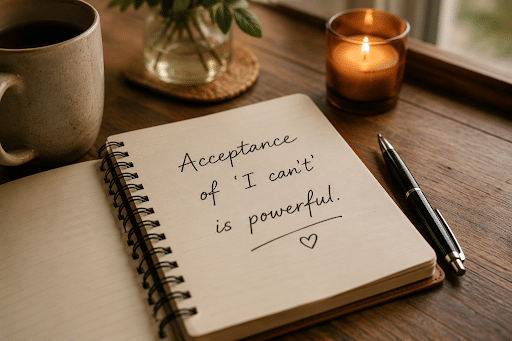
Before I left therapy that day, Gayle offered one more sentence. “Acceptance of ‘I can’t’ is one of the most powerful things we can do.” At first, the words felt heartbreaking. Because “I can’t” sounds so small. So limited. So insufficient.
But what I began to realize is that “I can’t” can also be profoundly honest. I can’t pretend this doesn’t hurt. I can’t disconnect from what my body knows. I can’t build real connection on emotional absence. I can’t keep turning against myself in order to maintain the illusion of closeness.
 Acceptance didn’t erase the grief. But it removed the confusion. And once confusion left, something else became possible:
- Peace.
- Not perfect peace.
- Not permanent peace.
But the kind that comes from no longer arguing with reality.
🌱 What This Experience Taught Me
- Some people cannot sit with discomfort—theirs or ours.
• Emotional availability is a capacity, not just an intention.
• Understanding someone’s limitations does not require abandoning ourselves.
• Acceptance is not giving up. It is choosing truth over confusion.
• Boundaries are not always loud. Sometimes they sound like, “I can’t keep doing this to myself.”
🔗 Final Thought
This kind of clarity isn’t just personal. It shapes how we lead. How we love. How we parent. How we communicate. How we build relationships that can actually sustain honesty.
Because people do not feel safe with us simply because we are kind. They feel safe when we can stay present with reality. Including painful reality. Including emotional complexity. Including truth that cannot be easily fixed. And perhaps that is the deeper invitation hidden inside all of this:
- To stop confusing love with the endless pursuit of unavailable connection.
- To stop measuring our worth by someone else’s capacity.
- And to understand that sometimes the most loving, honest, self-respecting thing we can say is: “I can’t.”
Looking to deepen the conversation?
Misti Burmeister speaks to leaders and teams about trust, communication, emotional capacity, and the human dynamics that shape real performance. Her work helps people notice what’s happening beneath the surface—so healthier cultures, stronger relationships, and more honest leadership can emerge.
If you’re exploring a speaker for an upcoming event, workshop, or retreat, Misti would love to connect.
Reach out: [email protected]
Here’s To Your Greatness,
Misti Burmeister
About Misti Burmeister
Misti Burmeister is an executive leadership coach, keynote speaker, and bestselling author who helps leaders communicate so people care and take ownership. Through Inspirion, she helps executives and teams navigate difficult conversations, strengthen trust, and recognize the internal reactions that undermine effective leadership. Her current body of work, Before the Reaction, explores how awareness in the moments before we respond creates greater clarity, choice, and connection.
Explore a speaking engagement or leadership conversation at MistiBurmeister.com or email [email protected].