
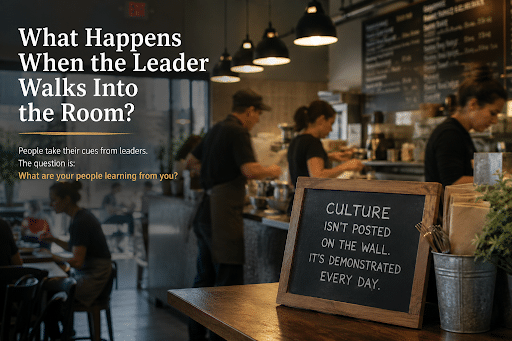
 There’s a local restaurant I visit from time to time.
The food is excellent. The coffee is excellent. The owner works incredibly hard.
And every time I go there, I notice the same thing.
The employees seem overwhelmed.
Not because they’re lazy. Not because they don’t care. In fact, the opposite appears to be true. They work hard—really hard.
One person is taking orders. Another is refilling coffee. Someone else is delivering food. Another is cleaning equipment. They move around one another like a choreographed dance, trying to stay ahead of the next task without getting in each other’s way.
From the outside, it looks efficient.
But there is something else happening, too.
The interactions often feel rushed. Customers seem more like one more thing to manage than people to serve. Questions are answered quickly. Patience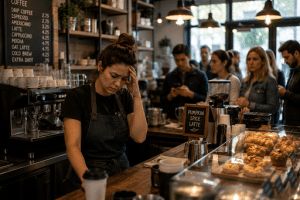 seems to run short. There is an edge to the atmosphere that is difficult to describe but easy to notice.
And I’ve watched this pattern repeat itself over the years.
The town has grown rapidly. Demand has increased. The restaurant is busier than ever. None of that is surprising.
What has always stood out to me isn’t how busy the place is. It’s how stressed everyone seems to be, including the owner.
Whenever I see her, she is talking about how busy she is, how much there is to do, how little time she has, and how hard everyone is working. The pace never seems to slow down. The pressure never seems to let up.
Recently, one of the managers stepped in to cover overnight baking after an employee left. She now gets up in the middle of the night to make sure the business can open each morning.
I’ve gotten to know her a little over the years. She follows my work online and always takes a moment to say hello when I stop in. She strikes me as thoughtful, kind, and committed to doing a good job. The kind of person who notices people. The kind of person who seems willing to do whatever needs to be done.
Which is why the conversation that followed stayed with me.
One day, I mentioned that I had seen her at the Lewes Leadership Lunch.
The owner’s response caught me off guard.
She couldn’t imagine how her manager had found the time to attend. Then she made a comment about how hard she was pushing her.
I won’t repeat the exact words. This is a small town, and that’s not the point.
What stayed with me wasn’t the comment itself. It was the assumption underneath it.
The manager’s attendance at a leadership event wasn’t viewed as an investment in her growth.
It was viewed as time away from work.
As I drove home that day, I found myself thinking about how often leaders unintentionally communicate the same message.
Growth is important—as long as it doesn’t interfere with productivity.
Learning matters—as long as it happens on someone else’s time.
Develop yourself.
Just don’t do it on the clock.
Then I thought about Ely.
A young woman getting up in the middle of the night to help keep the business running.
A person who was already giving more than most people would be willing to give.
And I found myself wondering:
If leaders don’t see growth as part of the work, why would employees?
If learning is treated as separate from the job, why would anyone view it as essential to the job?
And suddenly something clicked for me.
Leaders are always teaching. Not just through what they say, but
- through how they show up,
- what they celebrate,
- what they tolerate,
- and what they model for the people around them.
People take their cues from leaders. If the leader is calm, people tend to become calmer. If the leader is curious, people tend to become more curious. If the leader is constantly stressed and rushing from one thing to the next, people often begin operating that way too.
Leaders may not realize it, but they are constantly giving people permission about how to show up. Over time, that permission begins to shape how people work, communicate, solve problems, and relate to one another.
Instead of asking whether they’re doing meaningful work, people start asking whether they’re doing enough work. Instead of focusing on contribution, they focus on keeping up. Instead of bringing their best ideas forward, they begin managing perceptions.
Not because they’re bad employees.
Because they’re adapting to the environment around them.
And sometimes the consequences show up in places leaders don’t expect.
Innovation slows. Initiative disappears. Customer interactions become transactional. And over time, retaining good people becomes more difficult.
I’ve noticed that at this restaurant too.
Faces come and go. People I had gotten used to seeing disappear, only to be replaced by someone new.
I don’t know all the reasons people leave. None of us ever do. But it has often left me wondering whether the pressure I sense as a customer feels even greater on the other side of the counter.
One of the most revealing questions I ask leaders is this:
What happens when you walk into the room? 
Do people become more engaged, more thoughtful, and more willing to contribute? Or do they become more cautious, more hurried, and more concerned about proving they’re working hard enough?
Many leaders assume that pressure creates performance.
And in the short term, it often does.
People move faster. They work longer. They become more careful. They do whatever they can to avoid falling behind.
But pressure and performance are not the same thing.
Pressure can create activity. It can create compliance. It can even create short-term results.
What it rarely creates is ownership.
Ownership grows when people feel trusted. It grows when people have room to think, contribute, learn, and occasionally make mistakes. It grows when leaders create conditions where people can bring their full selves to the work instead of constantly managing fear, urgency, or perception.
The best leaders I’ve met hold high standards, but they don’t rely on pressure to achieve them. They understand that people perform best when they feel challenged and supported, accountable and trusted, responsible and respected.
Which brings me back to that restaurant.
I don’t know everything that happens behind the scenes. I don’t know the pressures the owner carries. I don’t know what it’s like to run that business.
What I do know is this: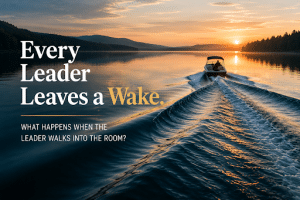
Every leader leaves a wake.
The question is whether that wake leaves people feeling energized or exhausted. Whether it leaves them growing or merely surviving. Whether it inspires them to contribute or simply teaches them to cope.
And often, you don’t have to ask people which one it is.
You can see it the moment the leader walks into the room.
Here’s your greatness,
Misti Burmeister
Misti Burmeister is a leadership communication expert who helps founder-CEOs and senior leaders build trust, strengthen accountability, and create ownership through courageous conversations and human-centered leadership. Her work focuses on helping leaders notice what others miss in human dynamics so they can communicate in ways that help people succeed — not just comply.