


A few days ago, my wife logged off a company-wide meeting and sat quietly for a moment. She works for a video game studio that has experienced layoffs every year since being acquired by a much larger company. Like many people in gaming and technology, she has learned to live with a certain amount of uncertainty. Still, this felt different.
Just days earlier, employees had learned that layoffs were expected across the company in early July. Naturally, people hoped the all-hands meeting would provide some clarity. Instead, the president opened with the words, “This meeting is not about layoffs.”
He then spent several minutes talking about the game they were working on almost entirely in the past tense. As he spoke, he became emotional and started to cry. Moments later, the COO began crying as well. Less than ten minutes after the meeting began, it ended. No explanation. No additional information. No clarity. Just a room full of people left wondering what had happened.
As someone who studies leadership communication, I immediately thought about Brené Brown’s observation that clear is kind and unclear is unkind. I don’t believe the president intended harm. In fact, I suspect he was doing the best he could with the information he had. Leadership can be lonely, especially when you don’t yet have answers. Sometimes leaders are carrying fears, concerns, and realities they cannot fully share. But intentions don’t erase impact. When leaders communicate fear without clarity, people are left to fill in the blanks. And the stories people create are often worse than reality.
Over the next several days, my wife and I found ourselves discussing questions neither of us could answer…
- Should she use the sabbatical time she still has available?
- Should she continue investing the same level of energy into a project that may or may not exist in a few months?
- Should we be exploring other opportunities?
- What happens if the studio survives?
- What happens if it doesn’t?
- What happens with healthcare?
- What happens with income?
- What happens to the plans we thought we understood just a few weeks ago?
Not long ago, it seemed entirely possible that she would receive a raise and a promotion. Now we were talking about whether the studio itself would survive. That kind of uncertainty does something to people.
Three days later, I found myself awake at four o’clock in the morning trying to solve a future that hadn’t happened yet. My mind was racing through every possible scenario.
- What if the company closes?
- What if it doesn’t?
- What if we should have saved more?
- What if I should have grown my business faster?
- What if we’ve made mistakes that are only becoming visible now?
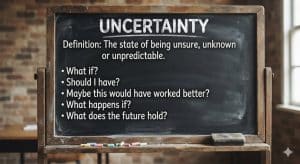 The more questions I asked, the more futures I created. And somewhere in the middle of all that worrying, I realized something important. I wasn’t trying to solve a problem. I was trying to solve uncertainty. The problem is that uncertainty cannot be solved in advance.
As I lay there, an image came to mind: a person standing in a windstorm. The goal isn’t to stop the wind. The goal isn’t to pretend it isn’t there. The goal isn’t even to convince yourself that everything will be okay. The goal is to feel the wind while keeping your feet on the ground.
The uncertainty is real. The possibility of loss is real. The fear is real. But that doesn’t mean we have to live through every possible future before it arrives. We don’t get to choose whether the wind blows. We don’t get to choose whether fear shows up. We don’t get to choose whether uncertainty feels uncomfortable. What we do get to choose is whether we allow fear to carry us away.
Years ago, I started using the phrase “don’t grab the rope” as a reminder to myself. When uncertainty shows up, my mind immediately wants to pull on something. It wants answers. Control. Certainty. It wants to figure out today what can only be revealed tomorrow. “Grabbing the rope” is what happens when I start carrying problems that don’t yet exist. It’s replaying the same worries over and over, believing that if I think about them long enough, I’ll somehow make myself safer. It’s trying to manage outcomes that are not available to manage. The rope feels useful because it gives me something to do. In reality, it usually just gives me rope burn.
For me, the ropes have names. They are the future, worst-case scenarios, financial projections, other people’s fears, and questions that simply cannot be answered today. The mind keeps making the same promise: “If you think about this long enough, you’ll finally feel safe.” I’ve never found that to be true.
What eventually brought me back to the present was a simple realization: We are not in a bad place. We are in an uncertain place. Those are not the same thing. We have a home. We have food. We have healthcare. We have savings. We have people who love us. We have options. None of those realities eliminate uncertainty, but they remind me that uncertainty and danger are not synonyms.The truth is that much of what I value most in my life emerged from uncertainty. I didn’t know whether moving to Delaware would work. I didn’t know whether Lewes Leadership Lunch would resonate. I didn’t know whether my writing would find an audience. I didn’t know which opportunities would appear next.
 The next step rarely reveals itself years in advance. It usually appears one step at a time… and maybe that’s what trust looks like. Not certainty. Not guarantees… Just the willingness to stay grounded long enough for the next step to reveal itself. I still don’t know what will happen with my wife’s company. The studio may survive. It may not. Life may look very different a year from now. Or it may not. What I know is that fear cannot solve a future that hasn’t happened yet – opportunities we cannot yet see. None of that is available to me today. What is available to me is this moment.
And perhaps that’s the invitation for all of us when life becomes uncertain. Feel the wind, stay where your feet are, and notice the urge to reach for the rope. The rope promises certainty… It promises control… It promises safety, but most of the time, it simply keeps us from being present long enough to discover what comes next.
Here’s to your greatness,
Misti Burmeister
Misti Burmeister is a leadership communication expert who helps founder-CEOs and senior leaders build trust, strengthen accountability, and create ownership through courageous conversations and human-centered leadership. Her work focuses on helping leaders notice what others miss in human dynamics so they can communicate in ways that help people succeed — not just comply.