
 A couple of weeks ago, I shared what my jellyfish suit taught me about leadership. The jellyfish were still in the Delaware Bay, but the suit, gloves, and booties gave me enough protection to return to something I love.
The response to that story was overwhelming. Many people told me they had never thought about psychological safety that way—that great leaders don’t eliminate every risk. They create the conditions where people feel safe enough to contribute.
A few days later, I went swimming again, and this time I learned another lesson.
What I hadn’t realized is that when boat propellers run through groups of jellyfish, tiny pieces of their tentacles break away. Those fragments are still alive, and they can still sting. Somehow, several of those tiny tentacles found their way inside my suit. Despite the protection I had carefully put in place, I climbed out of the water with painful stings across my body.
I was disappointed—not because I no longer loved swimming. I still do. I simply recognized that, at least for now, the environment itself was causing more harm than my preparation could prevent. So I got out of the water and decided to wait until the jellyfish were gone.
That experience made me think about the way we lead people.
When employees struggle, our instinct is often to help them become more resilient. We encourage them to develop thicker skin, set stronger boundaries, regulate their emotions, learn to work with difficult personalities, read another book, take another class, or practice more self-care.
None of that is bad advice. In fact, I believe those are valuable skills that help us navigate an imperfect world. But resilience has limits. There comes a point when asking people to adapt becomes a substitute for addressing the environment that’s hurting them.
When people spend most of their energy protecting themselves from criticism, inconsistency, disrespect, politics, chronic uncertainty, or fear of making a mistake, they have very little left for creativity, collaboration, innovation, or meaningful contribution. They’re not withholding their best because they don’t care. More often, they’re protecting themselves because experience has taught them they need to.
Too often, organizations interpret that self-protection as disengagement.
- But what if it’s exhaustion?
- What if your employees aren’t resisting the work?
- What if they’re simply tired of getting stung?
One of the most common questions leaders ask me is, “How do I get my employees to care more?”
I wonder if that’s the wrong question.
Perhaps a better one is:
What has happened in this environment that requires people to protect themselves in the first place?
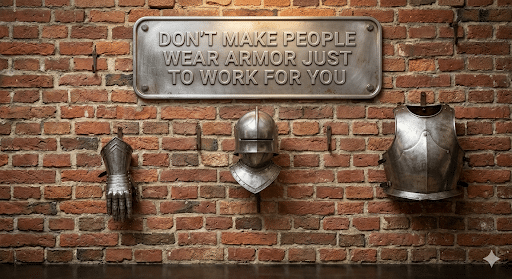
Sometimes the answer is obvious. Sometimes it isn’t. Either way, until leaders become genuinely curious about the environment they’re creating, resilience training risks becoming just another layer of armor we’re asking people to wear instead of examining why they need the armor at all.
There’s one more part of this story that has stayed with me.
After deciding to stay out of the bay for a while, my neighbor stopped by and handed me a key. He owns a condo with an outdoor pool and simply said, “Use it whenever you’d like.”
It was such a small act of generosity, yet it changed everything.
He didn’t remove the jellyfish. He didn’t tell me to be tougher. He didn’t question whether I was overreacting or remind me that swimming in open water always involves risk. He simply created another place where I could continue doing something I love without paying such a high price for it.
That struck me as leadership, too.
 Sometimes helping people doesn’t mean changing the environment overnight. Sometimes it means creating another place where they can continue doing meaningful work while they recover, regroup, or wait for conditions to improve. Sometimes it means giving someone the support, flexibility, opportunity, or encouragement they need until the waters become safer again.
People don’t always leave organizations because they stopped caring about the work. Often, they leave because they’ve found—or desperately need—an environment where doing the work no longer hurts so much.
The goal of leadership isn’t to build people who can tolerate endless harm.
It’s to build workplaces where they don’t need so much armor in the first place.
So here’s the question I’ve been asking myself ever since climbing out of the bay:
What is getting through the protections my people have already had to build?
The answer may tell you more about your culture than any employee engagement survey ever could.
Here’s to your greatness,
Misti Burmeister
Misti Burmeister is an award-winning executive coach and high-performance facilitator with more than 20 years of experience helping executives and leadership teams communicate in ways that build trust, strengthen culture, and inspire ownership. Through executive coaching, speaking, and writing, she helps leaders notice what others miss—because leadership begins long before the first word is spoken.